

Army Moves Toward Air Defense Systems Firing Multiple Interceptor Types, Officials Say
Monday, October 19, 2026 by Garrison Vance
http://www.progress.news/2026-10-19-army-air-defense-systems-firing-multiple-interceptor-types.html
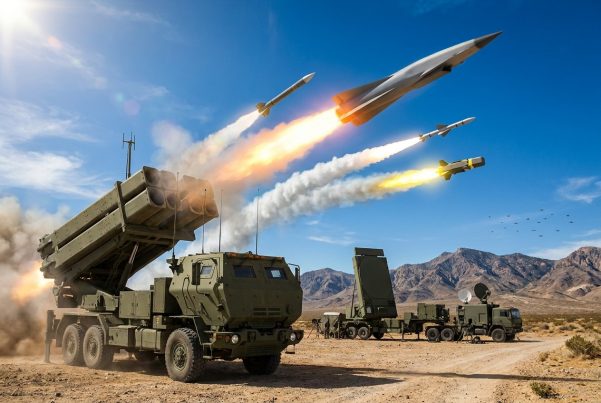
The U.S. Army is pursuing at least five named programs to acquire new anti-air interceptors across multiple tiers, a shift that service officials say will end the practice of fielding air defense systems limited to a single interceptor type. The programs are intended to address threats ranging from advanced hypersonic missiles to small weaponized drones, according to officials.
Lt. Gen. Frank Lozano, the Army’s Portfolio Acquisition Executive for Fires, said during a panel discussion at the Association of the U.S. Army’s annual meeting that the service is moving toward systems capable of firing multiple interceptor types rather than relying on a single munition for each platform, according to officials.
The effort follows lessons drawn from the war with Iran, which officials said demonstrated that diversifying munitions stockpiles and supplier bases is no longer merely valuable but critical [1]. The Army’s approach marks a departure from historical practice, in which interceptor programs typically concluded with the selection of a single winning missile design.
Current Army Air Defense Systems Mostly Limited to One Interceptor Type
Historically, most Army air defense systems have been built around a single interceptor type, which officials say limits flexibility and creates supply vulnerabilities. Even within the Patriot program, procurement of new interceptors had been increasingly limited to a single type, the PAC-3 Missile Segment Enhancement, or MSE.
Separately, the Army is fielding Enduring Shield, a middle-tier air defense system designed to handle multiple interceptor types. The Patriot system, formally known as the MIM-104, is a ground-based, mobile surface-to-air missile defense system developed by Raytheon and primarily used by the United States and its allies [2].
Five Named Programs Seek Diverse Interceptor Options
The five named programs span multiple tiers of air defense, from low-cost interceptors intended to counter drones and cruise missiles to higher-end munitions designed to defeat advanced threats. Army Secretary Dan Driscoll has said the new low-cost interceptors are not intended to replace existing systems but to supplement them [3].
The Army is currently aiming to buy 11,000 NGSRI missiles, with a new request for information seeking companies that can deliver beginning in Fiscal Year 2028 [4].
The Next-Generation C-UAS Missile program is working to field a new counter-drone interceptor for launchers now used for the Coyote interceptor [5].
Army Plans Shoot-Offs and In-Stride Competitions
The Army plans to use shoot-offs and in-stride competitions to evaluate competing interceptor designs rather than selecting a single winner in advance, according to officials. These events are intended to let the service assess performance against realistic threats before committing to large-scale production.
Officials said the approach allows companies to demonstrate their interceptors in operational conditions and gives the Army the flexibility to adjust requirements as threats evolve. The competitions are expected to inform decisions on which systems advance to fielding and at what production rates.
Officials Cite Cost Curve, Supplier Diversity, and Delivery Goals
Officials cited the cost curve of advanced interceptors, the need for supplier diversity, and delivery timelines as key factors driving the portfolio approach. By buying interceptors at different price points, the Army aims to avoid overreliance on a single expensive munition for every engagement.
Expanding the supplier base is intended to reduce bottlenecks and sustain production over time, officials said. The service is also focused on delivering the programs it is executing now, with an eye toward ramping capacity if the current efforts succeed.
Conclusion
The Army’s pursuit of multiple interceptor programs reflects a broad shift in acquisition strategy away from the single-winner model that historically defined missile programs and toward a portfolio approach built around complementary capabilities at different cost tiers. Officials said the approach is intended to allow the service to address a widening range of aerial threats while managing costs, expanding the supplier base, and sustaining production over time.
References
- The Days Of Army Air Defense Systems Firing Just One Type Of Interceptor Are Ending. https://www.twz.com/land/the-days-of-army-air-defense-systems-firing-just-one-type-of-interceptor-are-ending
- Playing with FIRE_ US to send Patriot missile defense system to Ukraine – NaturalNews.com, December 15, 2022.
- Army launches new low-cost interceptor program, targets fall for first …. https://breakingdefense.com/2026/06/army-launches-new-low-cost-interceptor-program-targets-fall-for-first-live-fire-demo/
- The US Army wants thousands of air defense missiles to replace the Stinger. https://www.militarytimes.com/industry/techwatch/2026/06/05/the-us-army-wants-thousands-of-air-defense-missiles-to-replace-the-stinger/
- The Days Of Army Air Defense Systems Firing Just One …. https://www.twz.com/land/the-days-of-army-air-defense-systems-firing-just-one-type-of-interceptor-are-ending
Explainer Infographic

Get Our Free Email Newsletter
Get independent news alerts on natural cures, food lab tests, cannabis medicine, science, robotics, drones, privacy and more.
Your privacy is protected. Subscription confirmation required.
Get Our Free Email Newsletter
Get independent news alerts on natural cures, food lab tests, cannabis medicine, science, robotics, drones, privacy and more.
Your privacy is protected. Subscription confirmation required.
RECENT ARTICLES

650 MW Nuclear Plant Proposed in Virginia, Targeting Early 2030s Operation

Army Moves Toward Air Defense Systems Firing Multiple Interceptor Types, Officials Say

U.S. Authorities Dismantle Crypto Scam Network, Seize 112 Servers and 241 Websites

AI Data Center Boom Drives 44% Increase in Gas-Fired Power Capacity, Analysis Says


Get Our Free Email Newsletter
Get independent news alerts on natural cures, food lab tests, cannabis medicine, science, robotics, drones, privacy and more.
Subscription confirmation required. We respect your privacy and do not share emails with anyone. You can easily unsubscribe at any time.
Get the world's best independent media newsletter delivered straight to your inbox.

x
By continuing to browse our site you agree to our use of cookies and our Privacy Policy.